
How to Remove Facial Hair at Home Without Pain: 7 Methods Compared
Seven methods compared: pain, results and sensitive skin.
 By VIFERA Team · · Updated

Seven methods compared: pain, results and sensitive skin.
By VIFERA Team · · Updated
Key takeaways
If you've ever sat in a parlour chair with tears in your eyes while someone threaded your upper lip, you're not alone. For most of us, facial hair removal has always meant a little bit of pain, a little bit of redness, and a monthly trip we'd rather skip.
But it doesn't have to be that way. There are gentler ways to remove facial hair at home, some completely painless. Here's an honest comparison of 7 popular methods, how long each one lasts, which ones hurt, and how to choose the right one for your skin.
Almost every woman has some facial hair: fine peach fuzz on the cheeks, a few darker hairs on the upper lip or chin, stray hairs between the brows. Genetics, hormones and age all play a part. Removing it is a personal choice, not a necessity. If you choose to, you deserve a method that's kind to your skin.
(If you've noticed a sudden increase in thick, dark hair, jump to "When to see a doctor" at the end.)
How it works: tiny blades cut hair at the surface of the skin.
Pain: none.
How long it lasts: a few days, depending on how fast your hair grows.
Good for: upper lip, chin, cheeks, sideburns, peach fuzz and tidying the brows.
Pros: no pain, no chemicals, no waiting time, gentle on sensitive skin, takes a minute, and you can do quick touch-ups anytime.
Cons: regrowth shows sooner than methods that remove hair from the root.
How it works: a small, single-blade razor glides over the skin, removing peach fuzz and some dead skin.
Pain: none, if done gently.
How long it lasts: a few days to a week.
Pros: smooth skin, and makeup sits nicely.
Cons: there's a risk of small nicks if you press too hard or use a blunt blade. Not ideal on active acne.
How it works: chemicals break down the hair so it can be wiped away just below the surface.
Pain: none, unless your skin reacts.
How long it lasts: a little longer than shaving.
Pros: quick and painless.
Cons: it can cause redness, irritation and even chemical burns if left on too long. You must use a face-specific cream, patch test first, never use it on your eyebrows, and stick to the timing on the pack.
How it works: it lightens dark hair so it's less visible.
Pain: usually just a tingle, though some people feel stinging.
How long it lasts: until the hair grows out, usually a few weeks.
Pros: no hair removal needed.
Cons: the hair is still there, it can irritate sensitive skin, and it needs a patch test.
How it works: a twisted cotton thread pulls hairs out from the root.
Pain: moderate. Some say it's less painful than waxing, but the upper lip can sting a lot.
How long it lasts: 3 to 4 weeks.
Pros: precise, especially for brows, and long-lasting.
Cons: pain, redness and swelling afterwards, and a small risk of bumps or infection. It's not ideal if you're using retinoids.
How it works: wax sticks to the hair and pulls it out from the root.
Pain: moderate to high.
How long it lasts: 3 to 4 weeks.
Pros: long-lasting, smooth results.
Cons: pain, redness, risk of burns from hot wax, and possible irritation or ingrown hairs.
How it works: tiny tweezers inside the device pull hairs out from the root.
Pain: moderate to high, especially on the face.
How long it lasts: around 3 to 4 weeks.
Pros: long-lasting, and a one-time buy.
Cons: it hurts, especially at first, and can cause redness, bumps and ingrown hairs.
Completely painless: facial trimmer, dermaplaning razor, hair removal cream (if your skin tolerates it) and bleach (which only lightens).
Painful but longer-lasting: threading, waxing and epilating, which remove hair from the root and last about 3 to 4 weeks.
Most gentle on sensitive skin: a facial trimmer, because it uses no chemicals, no heat and no pulling.
No. This is one of the most common beauty myths. According to Cleveland Clinic, shaving (and the same goes for trimming) won't make hair grow back thicker or faster. Trimming only cuts the hair at the surface; it never touches the root, where growth is decided.
Regrowth can feel a bit coarse at first, because the tip is cut straight instead of tapering naturally. As it grows out, it softens.
Our 2-in-1 is Amazon's Choice, rated 4.1 out of 5 from 7,589 Amazon ratings.
Fine facial hair is normal. But see a doctor if:
A doctor can find the cause and suggest treatments that reduce growth over time.
Removing facial hair doesn't have to hurt. If you want something quick, painless and gentle on your skin, a facial trimmer is the easiest place to start. If you prefer longer-lasting results and don't mind some pain, threading or waxing still work. And whatever you choose, remember: it's your face, your choice.
Sources
Facts and prices checked on 5 October 2026.
A facial trimmer is completely painless, because it cuts hair at the surface instead of pulling it out. It also uses no chemicals, which makes it gentle on sensitive skin.
No. Trimming only cuts hair at the surface and doesn't affect the root, so it can't change how thick or fast hair grows. Regrowth may feel blunt at first, but it isn't thicker.
Use a facial trimmer with a small rounded head. Stretch the skin gently, glide in small strokes, and use good light. It takes about a minute.
Only face-specific creams, and only after a patch test. Never use body creams on your face, never use any cream on your eyebrows, and don't leave it on longer than the pack says.
Whenever you notice regrowth, usually every few days to a week. Because trimming is painless and quick, frequent touch-ups are easy.
Hormonal changes, PCOS, some medicines and menopause can all cause more facial hair. If it appears suddenly or comes with irregular periods or other symptoms, see a doctor.
For most skin, yes. It cuts hair at the surface instead of pulling it out, with no chemicals or heat. Use it on clean, dry skin, skip cuts and active breakouts, and keep the head clean. It doesn't make hair grow back thicker.
Yes, if it has a head for the face. VIFERA's 2-in-1 trimmers come with a slim tip for the brows and a rounded head for the upper lip, chin and cheeks, so one tool does both.
Pastes like besan and turmeric are popular, but there's little evidence they remove hair. A facial trimmer is a gentle, chemical-free option that works straight away: it cuts hair at the surface, with no heat or pulling.
 2-in-1 Face & Brow Trimmer (White)Two heads, a built-in light and USB charging₹285
 2-in-1 Face & Brow Trimmer (Gold)Two heads in a slim, textured gold body₹335
 2-in-1 Eyebrow & Facial Grooming PenTwo heads, an LED light and a top mirror₹285
 Facial Hair RemoverOne round head, one switch and a soft light₹275
More Face guides
 How to Remove Facial Hair Naturally at Home: What Works and What Doesn't
Besan, turmeric, sugar wax or a trimmer: what really works.
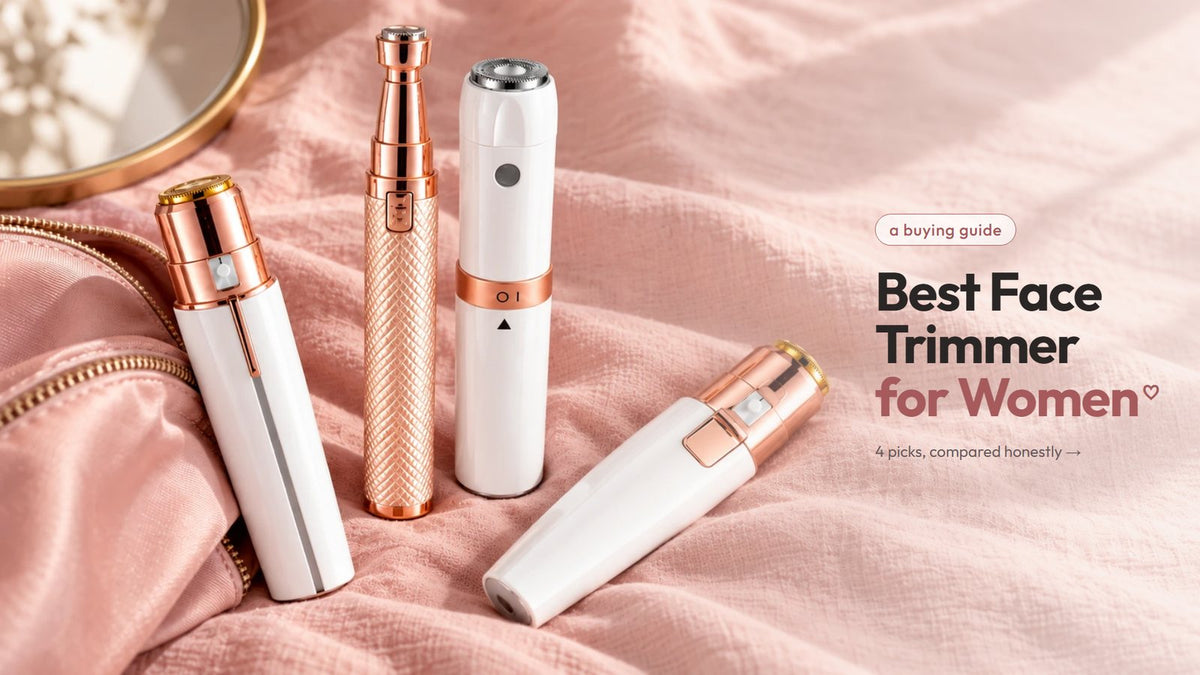 Which Face Trimmer Is Best for Women? A Buying Guide for India
What to look for, head by head, before you buy.
 How to Use a Face Trimmer: Step by Step for the Upper Lip, Chin and Brows
Step by step for the upper lip, chin, cheeks and brows.
Painless trimmers for your face, brows and body. Smooth whenever you want, wherever you are.
Shop the range

